To an outsider, the Quebec North Shore and Labrador Railway (QNS&L) might look like just another industrial line. To the people of Western Labrador, it is the mechanical spine of the whole region. Without this ribbon of steel, the towns of Labrador City, Wabush, and Schefferville would not exist.
The QNS&L runs through some of the harshest terrain on the continent, and for decades a privately owned ore railway doubled as the public lifeline for three towns. This is the story of how a railway nobody thought could be built became the heartbeat of the North.
The “Impossible” Construction
When the Iron Ore Company of Canada (IOC) first proposed the railway in 1950, the engineers who looked at it did not mince words: it was going to be a brutal job. The plan called for 360 miles (579 km) of track through swamps, mountains, and the hard rock of the Canadian Shield, with no roads anywhere to bring in supplies.
Faced with this logistical wall, IOC launched what was, at the time, the largest civilian airlift in history. Everything had to fly. Small aircraft ferried bulldozers, cement mixers, and armies of men into the remote wilderness. By 1952, the makeshift airstrips carved along the railway route were logging more traffic than Dorval Airport in Montreal.
The route was pure brute force. It climbed from sea level at Sept-Îles, Quebec, up through the steep canyons of the Moisie River, across the bare Labrador plateau, and on into the iron-rich interior. To get clear of the Moisie Canyon, crews blasted a 2,191-foot tunnel through solid granite, still the line’s greatest piece of engineering.
Against all odds, the “Last Spike” was driven in February 1954 by Jules Timmins and George Humphrey. The impossible railway was completed a full year ahead of schedule.
The Steel Pipeline
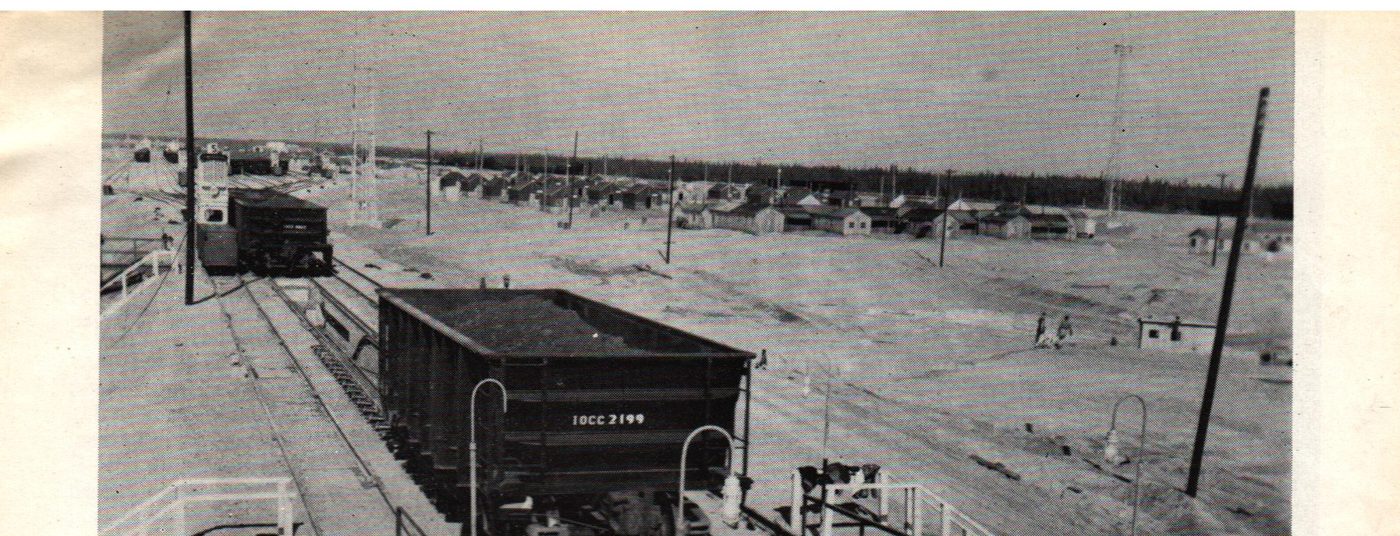
The QNS&L was never meant to move televisions or grain. It was a heavy-haul railway built for one job: moving iron ore. In practice it works less like a train and more like a steel pipeline on wheels.
The trains are enormous. A typical ore train runs 2.5 to 3 kilometres long and weighs about 24,000 tonnes. Each one is made up of roughly 240 cars pulled by three or four SD70ACe diesel locomotives.
Moving that much weight takes some clever engineering. The trains are so long that putting all the engines at the front would tear them in half, so the QNS&L was an early adopter of “Locotrol,” radio-controlled locomotives placed in the middle of the train to push and pull at the same time. On a single-track line, getting these trains past each other on sidings spaced every few miles, without ever stopping the flow of ore, takes constant, careful timing.
The Lifeline of the North
Unlike most mine railways, which are treated as private driveways, the federal government designated the QNS&L as a “Common Carrier.” This rule meant IOC was legally obligated to carry passengers and freight for the general public, not just their own employees.
For fifty years, until the highway was finally finished, the QNS&L was the lifeline for Labrador City. Everything came in on the freight train: fresh milk and lettuce, new pickup trucks, living room furniture.
The passenger service, known to everyone as “The White Train,” built a culture of its own. For a long time it was the only way out of town. A generation of teenagers grew up riding it all the way to Sept-Îles just to eat at McDonald’s, years before Labrador City had one of its own. People would ship their cars south by rail and fly out on company planes to meet them for vacation.
For kids growing up playing hockey, the minor hockey teams from Labrador City and Wabush made the annual train ride to Sept-Îles, Quebec, to play in the hockey tournament. This annual pilgrimage was as much fun for the kids as it was for the parents who went along. If Labrador City or Wabush were on the ice, it was guaranteed that players, coaches, and parents were at the rinks cheering for the team from Labrador West.
The Great Split
In 2005, the railway underwent a historic shift. The IOC decided it no longer wanted to manage the passenger service to Schefferville after the local mine closed. In a landmark deal, IOC sold the northern section of the line (from Emeril Junction to Schefferville) to a consortium of three First Nations: the Innu Takuaikan Uashat mak Mani-Utenam, the Naskapi Nation of Kawawachikamach, and the Innu Nation of Matimekush-Lac John.
This new entity, Tshiuetin Rail Transportation, became the first Indigenous-owned railway in Canada. Today, the line is split: IOC retains ownership of the QNS&L from Sept-Îles to Labrador City for moving ore, while Tshiuetin owns the track from the junction up to Schefferville, moving people and freight.
The River and the Monopoly
For all the modern equipment, the railway is never really safe from the country it runs through. The southern 50 miles are the most spectacular and the most dangerous stretch of the line. There the track crosses the Moisie River, the “Nahanni of the East,” on a bridge 155 feet above the whitewater. In spring, rockslides and avalanches are a constant threat, so IOC runs specialized “Hi-Rail” trucks fitted with sensors along the tracks to make sure a boulder hasn’t blocked the line before a 20,000-tonne train comes around the bend.
Today, the QNS&L is also a source of tension. It represents a strategic monopoly. Other mining companies, such as Champion Iron at Bloom Lake, require the railway to get their ore to port. Because IOC owns the tracks, they charge tariffs to their competitors, sparking numerous legal battles over “access rights” and fair pricing. The IOC argues that because they built it, they control it; competitors argue that the “mechanical spine” is an essential public utility that should be open to all.
Did you ride the White Train? The trips to Sept-Îles, the hockey tournaments, the freight that kept the town alive — share your railway memories in the comments below.
Comments
Loading comments…
Have a memory, a correction, or a name to add? Sign in with Google to leave a comment. Comments are reviewed before they appear.