The story of Wabush Mines is the story of the “Little Brother” that fought to survive. The Iron Ore Company of Canada (IOC) was the giant down the road in Labrador City; Wabush Mines was smaller, scrappier, and technically more complex. Its whole history turns on a single chemical flaw in the rock. Manganese eventually killed the mine, and decades later new technology brought it back to life.
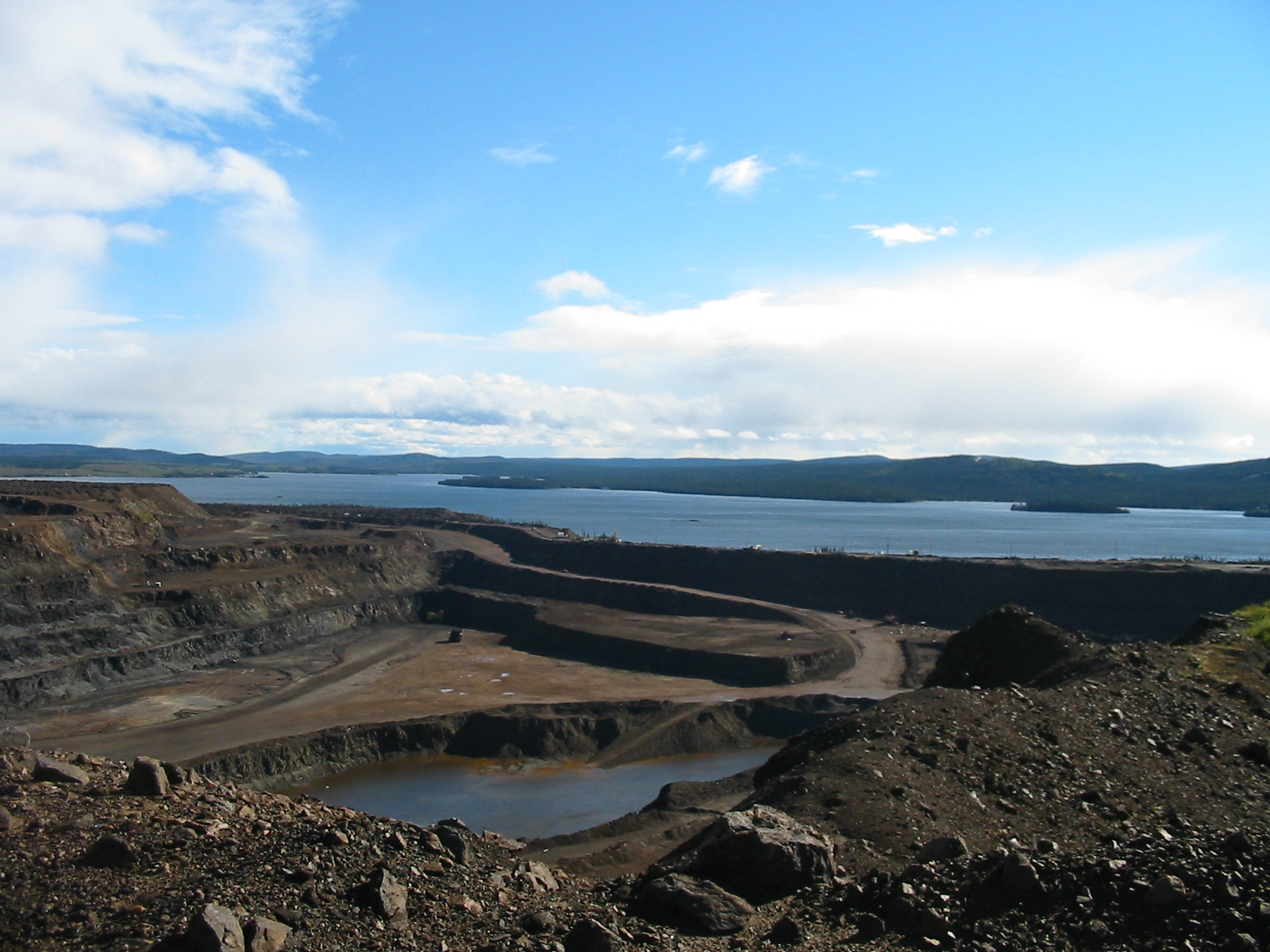
The Beginning: The Consortium (1950s–1965)
While IOC was a single massive corporation, Wabush Mines was born as a consortium. In the 1950s, several smaller American and Canadian steel companies, who preferred not to buy from their competitor IOC, banded together to secure their own supply.
- The Manager: The operation was managed by Pickands Mather & Co. out of Cleveland, Ohio.
- The Partners: The ownership group included Canadian giants Stelco and Dofasco from Hamilton, alongside American firms like Inland Steel.
- The Construction (1961–1965): The consortium built the Scully Mine, named after V.W. Scully, Chairman of the Board of The Steel Company of Canada (Stelco).
- The Town: Because Labrador City was strictly an “IOC Town,” the partners built their own town next door: Wabush.
IOC had built a massive railway from scratch. Wabush Mines could not afford to. Rather than run a line all the way to the ocean, the consortium built a short spur, the Wabush Lake Railway, to connect to IOC’s QNS&L line, then paid IOC to carry its ore to the coast.
The Manganese Curse
From day one, Wabush Mines had a geological problem: the iron ore in the Scully pit contained high levels of Manganese. In small amounts, manganese is acceptable, but if the concentration is too high, it damages the blast furnaces used to make steel.
For fifty years, the engineers at Wabush were constantly fighting to blend the ore to keep the manganese levels low enough to sell. It was a constant handicap that made their production costs higher than IOC’s.
Unlike IOC, which centralized operations in Labrador City, Wabush Mines was a split operation. The Scully Mine in Wabush dug the rock and crushed it into “Concentrate” powder. This powder was shipped south by rail to Pointe Noire in Sept-Îles, Quebec, where a separate Pellet Plant turned the powder into pellets before shipping.
The engineers never stopped looking for an edge. By the late 1960s the Pointe Noire plant had become one of the first iron ore pelletizing operations in the world to pioneer dry-grinding ball mill technology, which sharply reduced grinding ball consumption and cut operating costs. The company’s own Bulletin reported that the program was expanded to more mill circuits in 1969. For a mine that was always paying more than its competitors, that kind of small technical gain was not a luxury. It was survival.
The scrappiness showed early. A serious fire broke out at the Scully Mine in early 1966, and according to The Producer, the employee newsletter of Pickands Mather & Co., the mine was back in full operation within 54 days. At a site with no road access and a single rail link, that was a remarkable recovery, and it set the tone for how Wabush Mines would handle trouble for the next half-century.
The Cliffs Era: Boom and Bust (2007–2014)
The ownership quietly shifted over the decades. In late 1968, Pickands Mather & Co., the Cleveland firm that had managed Wabush from the start, was absorbed by Diamond Shamrock Corporation, the first in a long run of consolidations among the founding partners. By 2007, what was left of the original consortium sold the mine outright to Cliffs Natural Resources, a large American mining firm. It was the end of the founding-partner era and the start of something far more volatile.
Cliffs took over during the “Supercycle” when iron ore prices soared to over $150 per tonne. They ran the mine hard. Because prices were so high, Cliffs didn’t worry about efficiency. The Scully Mine became one of the highest-cost operations in North America as they spent huge amounts of money pumping water out of the deep pits and managing the manganese.
The crash came between 2013 and 2014. When iron ore prices collapsed to $90 and then $50 per tonne, the math broke. It cost Cliffs more to mine the rock than they could sell it for.
The Trauma: The 2014 Closure
On February 11, 2014, Cliffs announced the absolute closure of Wabush Mines. The impact was immediate and devastating:
- The Shutdown: 500 high-paying jobs vanished instantly.
- The Betrayal: Cliffs filed for creditor protection under the CCAA (bankruptcy protection for its Canadian division).
- The Pension Cut: In a move that enraged the province, Cliffs cut the pensions of retirees by roughly 21–25% and eliminated health benefits.
- The “Orphaned” Mine: Cliffs walked away, turning off the pumps. The pit began to flood; if the water rose too high, the mine would be ruined forever.
A small group of local engineers and the union maintained a vigil, keeping the pumps running on a skeleton budget and praying a buyer would be found before the water destroyed the equipment.
The Sears/Wabush Effect: A Legal Legacy
The story of Wabush Mines is often cited as a warning about foreign ownership. The financial devastation of the Wabush miners in 2014 served as the warning shot for the national collapse of Sears Canada in 2017, leading to the “Sears/Wabush Effect.”
It exposed a glaring loophole in Canadian bankruptcy law (the CCAA) that let corporations legally raid the deferred wages of their retirees to pay off banks and investors. Under the old rules, an “underfunded pension plan” was treated as unsecured debt, so the money simply vanished once secured creditors like the banks had been paid.
The Fight for Deferred Wages
Retirees argued that a pension is not a “benefit” at all but a deferred wage, money the workers had accepted in place of higher hourly pay and were now watching go to the banks. The Wabush Pensioners Committee joined forces with national organizations to shame the government into action.
This pressure eventually led to the Pension Protection Act (Bill C-228), which received Royal Assent in April 2023. The law fundamentally altered Canada’s bankruptcy laws by giving pensions “Super Priority,” ensuring they are paid before secured creditors.
However, for Wabush, it was a bitter irony. The law is not retroactive. The Wabush Mines retirees did not get their money back; they remain on reduced pensions, having won the war for future Canadian workers while losing their own battle.
The Resurrection: Tacora Resources (2017–Present)
Just when the town had given up hope, a new player arrived. Tacora Resources, a company formed specifically to save this mine, bought the assets in 2017.
Tacora’s advantage came down to new technology. They didn’t simply restart the mine; they fixed the flaw that had hobbled it. By installing Manganese Reduction Circuits built around high-intensity magnetic separators, they finally stripped out the manganese that had dogged the Scully pit for fifty years, producing a higher-grade, cleaner product.
In the summer of 2019, the Scully Mine roared back to life. Today, the mine is fully operational, shipping its concentrate via the railway to Sept-Îles for markets in Europe and Asia.
Did you work at the Scully Mine or the Pointe Noire pellet plant? Whether you remember the early consortium days, the 2014 shutdown, or the Tacora restart, share your story in the comments below.
Comments
Loading comments…
Have a memory, a correction, or a name to add? Sign in with Google to leave a comment. Comments are reviewed before they appear.