The history of the Iron Ore Company of Canada (IOC) is, in effect, the biography of Labrador West. It was one of the most successful and politically complicated industrial projects in Canadian history. Founded in 1949, IOC did more than mine ore. It built the towns, the railways, and the ports that made the mining possible, in a place where almost nothing had existed before.
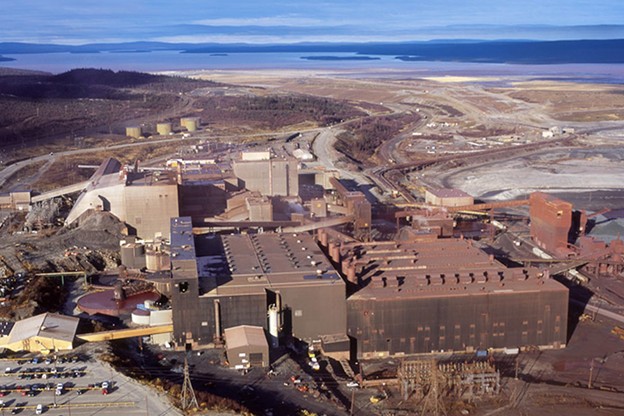
The Founding: “Operation Civilization” (1949–1954)
Following A.P. Low’s discovery of iron ore in the 1890s, the region sat untouched for fifty years due to its remoteness. However, the post-WWII boom saw American steel mills running low on domestic iron ore, prompting them to look north.
- The Consortium (1949): IOC formed as a partnership between the Canadian mining firm Hollinger and powerful American steel companies, led by the M.A. Hanna Company of Cleveland. This partnership guaranteed a market for whatever IOC mined.
- The Impossible Railway (1950–1954): Before any ore could be sold, IOC had to build the Quebec North Shore and Labrador Railway (QNS&L). It cost nearly $300 million (billions today) and required the largest civilian airlift in history at the time, flying heavy machinery into the bush so crews could lay track from north and south at once. To finance it, 19 American and Canadian insurance companies agreed to lend an additional $145 million on top of the partners’ own capital.
- The First Mine: Operations began at Knob Lake (Schefferville) in 1954. The ore there was “Direct Shipping Ore,” high-grade rock that could be dug up and thrown straight into a furnace.
The Political Architect: Smallwood’s Grand Design
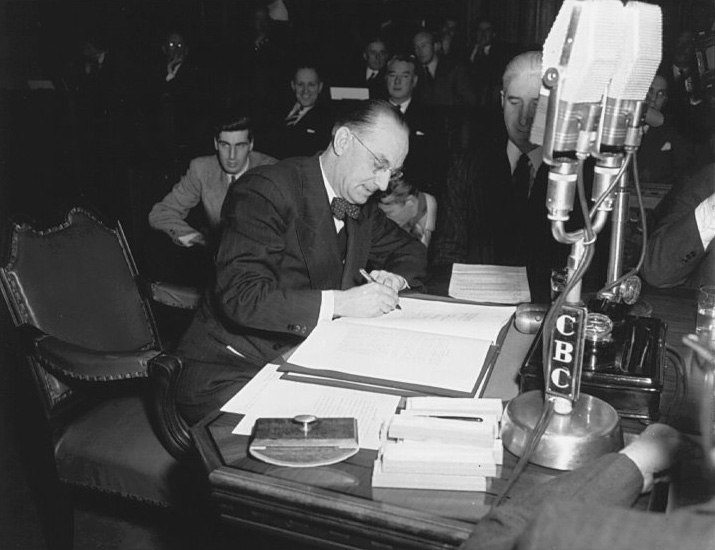
The industrial boom in Labrador West cannot be separated from the political ambition of Joey Smallwood, the first Premier of Newfoundland. When Newfoundland joined Confederation in 1949, the interior of Labrador was a dormant asset. Smallwood saw the iron deposits as more than a mine. To him they were the economic engine that would justify the new province’s existence.
To get the project moving, Smallwood granted IOC enormous concessions, including vast land rights and tax breaks. In return he demanded one thing that was not up for negotiation: jobs for Newfoundlanders.
Because the QNS&L railway started in Sept-Îles, Quebec, it was easier to hire workers from Quebec. Smallwood fought hard to keep Labrador City from becoming a “satellite of Quebec.” He pushed the companies to honour a “preference clause” for Newfoundland labour, which led to aggressive recruiting in the island’s outports and flew thousands of fishermen north to become miners.
The bond between the Premier and the company was cemented in 1962, when operations officially began and Smallwood himself set off the inaugural blast. In recognition of his role in opening the region, IOC named its flagship operation the Smallwood Mine.
The Strategic Pivot: The Carol Project (1960s)
By the late 1950s, the steel industry evolved. Furnaces began demanding “pellets” (processed concentrate) rather than raw rock. IOC realized its future lay further south in Labrador City.
In 1958, IOC announced the Carol Project, leading to the opening of the Smallwood Mine in 1962.
- The Technology: The ore here was low grade (38.4% iron), but IOC invested in new technology (Humphreys Spirals) to upgrade it to 66% concentrate on-site. This transformed Labrador City into a “factory” town rather than just a mine site.
- The Town: Unlike the temporary camps of the past, IOC designed Labrador City as a modern suburb to attract families, signaling a permanent commitment to the region.
- The Missing Link (1960): On May 22, 1960, a second Golden Spike ceremony marked the completion of a 38-mile spur line connecting the Carol Project to the QNS&L mainline. Jointly owned by IOC and Wabush Iron Company, that short stretch of track was the moment Labrador West became a permanent community rather than a camp.
The milestones came quickly. On August 1, 1964, exactly ten years to the day after the first iron ore shipment, the one hundred millionth ton of ore was loaded into the holds of the M.S. Monks-garth at the terminal in Sept-Îles. In a single decade, IOC had turned a blank spot on the map into one of the most productive mining operations on the continent.
The Corporate Crisis & The Closure (1980s)
The early 1980s marked the company’s darkest chapter. Global demand for steel collapsed, forcing IOC to choose between saving Schefferville or Labrador City.
The Mulroney Era (1977–1983)
This period serves as the origin story for Canada’s 18th Prime Minister, Brian Mulroney. Hired as President in 1977, Mulroney was a slick labour lawyer from Quebec known for his “golden throat.” His mandate was to bring labour peace to a company plagued by strikes. He brought a sense of glamour to the role, operating out of a corporate jet and drinking beer with union bosses.
However, the 1981–1982 crisis forced his hand. With the company losing millions, the American owners issued an ultimatum: cut the losses or face bankruptcy.
The “Black Day”: November 2, 1982
Mulroney made the decision to permanently close the Schefferville operations. It was a death sentence for the town of 4,000 people. Almost overnight, schools and arenas emptied, and houses were sold for $1.00 or bulldozed to avoid taxes.
Mulroney turned that ruthlessness into a political asset during his 1983 leadership bid. He negotiated a $9 million severance package for the workers and argued that, while he had to make the hard call to save the company, he had treated the men with dignity, which a “soulless American manager” would not have done.
For Labrador City, the legacy is mixed. Mulroney is remembered as the man who cut Schefferville loose to save the Carol Project, and also as the man who taught residents a hard lesson: if the numbers don’t work, the company will erase you.
The Rio Tinto Era (2000–Present)
In 2000, the global mining giant Rio Tinto acquired a majority stake in IOC, integrating Labrador West into a massive global network. The ownership structure now includes Rio Tinto (~58.7%), Mitsubishi Corporation (~26.2%), and the Labrador Iron Ore Royalty Corp (~15.1%).
The Future Frontier: Electrification and Automation (2020s–Present)
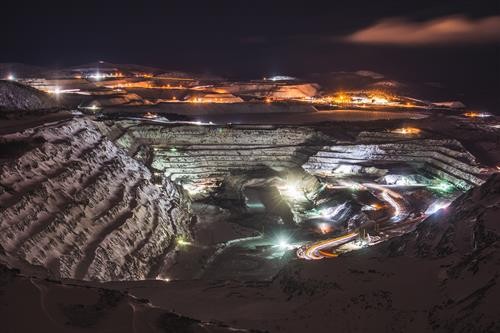
If IOC’s past was built on diesel machinery and physical labour, its future is being written in code and electricity. The company has rolled out a number of new technologies at its Labrador City operations, all aimed at electrification, automation, and the 2050 net-zero goal.
The “Ghost” Train: North America’s Hidden Electric Railway
Few people realize that IOC runs one of the last fully electric cargo railways in North America, separate from the main QNS&L line to Sept-Îles.
- The Autonomous Loop: Within the mine itself, a specialized 13-km fully electric railway transports raw ore from the mine pit to the processing plant (concentrator).
- The Tech: It utilizes GMD SW1200MG electric locomotives running on electricity delivered via overhead catenary wires.
- Automation: These trains are unmanned, operating on an automatic block system without a human operator in the cab.
Robots in the Pit: Autonomous Vehicles
The era of the operator sitting in a freezing cab is ending. IOC is a leader in deploying electric heavy machinery to improve safety and efficiency.
- Autonomous Drills: In a pilot project with FLANDERS, IOC has deployed autonomous electric blasthole drills (converted P&H 320XPC models). These machines are all-electric and controlled remotely from a warm office, removing operators from the dangerous pit environment.
- Laser Inspection: The tracks are monitored by high-speed laser and optical geometry cars (supplied by MERMEC) that scan the rails for defects while moving at speed.
The “Green Steel” Pivot
A major operational focus is replacing heavy fuel oil with clean electricity in the processing plants.
- The Electric Boiler: IOC is installing a 40-megawatt electric boiler to generate steam for the concentrate and pellet plants, replacing old heavy fuel oil boilers.
- Plasma Torches: The company is piloting plasma torch technology in its pellet induration machines, using electricity to generate the extreme heat that fossil fuels provide today.
- High-Grade Pellets: IOC now produces high-purity pellets for Direct Reduction (DR) steelmaking, a modern method that uses hydrogen instead of coal and depends on the exceptionally clean ore Labrador City can provide.
Did you or your family work for IOC? From the Smallwood Mine to the Carol Lake concentrator and the years that followed, we’d love to hear your memories. Add them in the comments below.
Comments
Loading comments…
Have a memory, a correction, or a name to add? Sign in with Google to leave a comment. Comments are reviewed before they appear.