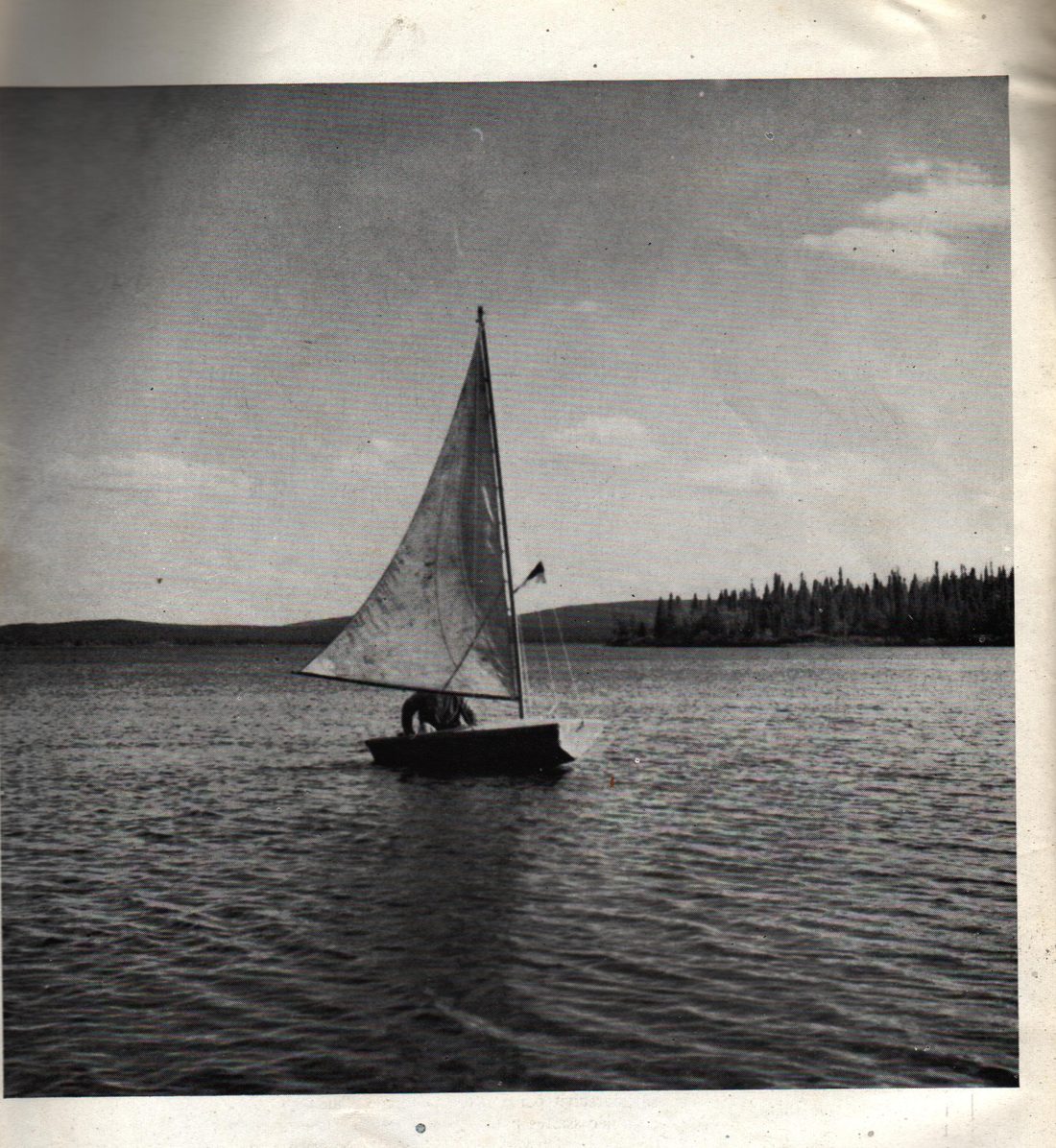
This is Wabush, Labrador. Three years ago, it was barren bush. Today it’s a bustling construction camp that’s as civilized as most suburbs. A man who knew this country both ways here gives a slightly shaken report on the changes.
ONE SEPTEMBER EVENING, while Maclean’s photo editor Don Newlands and I were roughing it in the bush, I had an extra dry Martini on the rocks, some snails Bourgogne, a bowl of pea soup, beef tenderloin with mushrooms, fresh hot rolls, Mexican corn, and a carafe of Beaujolais. I would have had a chef’s salad too, but they were out of lettuce. Nothing is perfect.
Later, Newlands and I walked across the street to watch the bowling and billiards, and then back to our hotel to see what was doing at a candlelight dance there. Not much was. I went upstairs to telephone my wife and settle down with that day’s edition of the Montreal Gazette.
All this took place, believe it or not—and as a onetime construction worker in the north, I am not certain I believe it myself—in a town called Wabush, Labrador, some two hundred miles north of Seven Islands, Que., six hundred and fifty air miles from Montreal and about the same from St. John’s (Newfoundland). With its twin settlement of Labrador City, three miles around a corner of the shore of Wabush Lake, Wabush forms a new mining community in Canada’s far, or at least fairly far, north. Labrador City, which started producing iron ore this year, has a population of about three thousand. Wabush, which will not start producing anything until next winter, has a population of about two thousand, of which seventeen hundred are workers and the rest are members of their families.
Three years ago, Wabush was “bush”: a rough, scraggly, nearly lifeless wilderness. The hills in summer echoed only with the whir of the black fly. The only way for a man foolish enough to want to go there was to do so by seaplane. The bush, like so many of the parts of Canada that have yet to be opened, had to be broken and tamed, and the men who broke it—the last frontiersmen—are a breed apart.
One of the subspecies of this breed is the college student. Boots shining, his university’s name emblazoned across the back of his windbreaker to shout “greenhorn” to the world, his first, soft beard struggling vainly to be seen, the student laborer is as much a part of the modern expansion of Canada as the bulldozer. I served three terms as one of these typically Canadian frontiersmen, on the three biggest construction jobs of my time. In 1954 I worked on the St. Lawrence Seaway. In 1953 I spent a summer at Kildala, the powerline project that was to link Kitimat, the aluminum refinery on the coast of northern British Columbia, with Kemano. The summer before that, though—1952—I worked on the QNS&L, the “Quebec North Shore and Labrador Railway.” This experience was gained in the same part of the world as Wabush, and it was hell.
The QNS&L was—as it is now—the railway designed to carry iron ore from the vast wilderness deposits around Knob Lake, three hundred and fifty miles north of the St. Lawrence, to Seven Islands on the river’s north shore. It was a tremendous task, costing more than $250 million and employing as many as 7,000 men at a time. After a tortuous passage through the hills and canyons of Quebec above Seven Islands, it crawls two hundred miles across the soggy muskeg of Labrador. Until the head of steel approached its last stage, there were many engineers—good men at their jobs—who said no one could build a railroad where the QNS&L was going.
For many weeks that summer I wished they had been right. Untrammeled by labor legislation in either Newfoundland or Quebec, the construction companies treated the men who did the work like serfs. Bold and aggressive in their engineering, they seemed coldly unaware that it was, in the end, men who were doing the job. We slept frequently in filth. We ate, while plentifully, dismally. Never, in the bush camps around where I was working only a decade ago, could I have imagined the new life on the last frontier as it is now lived in Wabush.
The Hotel
The hotel where I ate so well on my first night in camp is the aspect of Wabush that separates it most strikingly from the kind of Labrador bush camp I worked in as a student. Except for the rugged scenery outside the window—a dirt road in the foreground and the sweeping hills of spruce and tamarack beyond—this hotel, the Sir Wilfred Grenfell, could as easily be in Montreal as in a mining town. It has a curvy hostess named Christine, several pretty waitresses, a couple of switchboard girls, comfortable carpeted rooms, room service—everything, in fact, except radio or television, the lack of which one housewife in Wabush told me was the roughest thing about living there.
The roughest thing about the Grenfell hotel is the prices: $12 for a small single room and $18 for a double. You can do better than that at the Ritz Carlton in Montreal. The meal I described set me back about $6.
These prices, of course, keep most of the hotel’s facilities well out of the financial range of the working men. But the men are still able to—and do—use the tavern in its basement; beer costs $0.45 but is obviously welcome after a day of slugging on the job. On the QNS&L, when it would have been more welcome still, we would have been fired for smuggling it into the camps.
The Bunkhouses
The sheets at Wabush are changed every week. A man living in one of the company dormitories can also have all the laundry done he wants. The single men’s dormitories are not unlike houses at a good boys’ boarding school: three stories of long, monastic halls, with two or four men in each numbered room. To a man who had seen labor gangs living in boxcars at the head of steel, with one sheet each and no place to wash, these rooms still looked comfortable.
At Wabush, with its showers in every bunkhouse, its laundry services, and its women to be seen, there is, as one company official put it, “no excuse for a man not to be clean.” Newlands and I traveled to Wabush with a group of newspapermen from around Toronto, and when we got on the plane, I and the one other reporter—an old northern hand—were wearing sports shirts, talking condescendingly of the greenhorns around us going to appear in Labrador wearing jackets and ties. As it turned out, no one is even allowed into the Sir Wilfred Grenfell dining room unless he is wearing a jacket.
Both the costuming and the food are a little different at the company cafeteria, but not as much rougher as one might expect. The men, still in their working clothes, queue up to get to spanking-clean, glass-enclosed steam tables. One evening meal that I sat in on included, among many other items, fried chicken legs, corn on the cob, and ice cream. The bread is baked in the cafeteria basement every night and comes up fragrant in the morning. About the only concession the cafeteria makes to its remoteness is that the milk is powdered instead of fresh.
Two-Million-Dollar School in the Bush
Prices are outrageous. $0.45 for a quart of fresh milk. $0.29 for a handful of cottage cheese. Nearly $2 a pound for steak. One woman, with no children, told me her grocery bill often topped $40 a week, and there is one family there with eleven children.
The families live in row housing which is certainly as comfortable as many places I’ve looked at in Don Mills. There is quite a rigid grade system for distributing tenants—the map in the camp manager’s office frankly lists “Class A” and “Class B” houses—and if Wabush were much bigger it could properly be accused of segregating income groups.
There are schools in Wabush. The school system now is a temporary building that will eventually be converted to a housing unit. Perhaps the showpiece of the whole camp is a new two-million-dollar school that will have, under Newfoundland’s cumbersome system, one wing for Catholic students, one wing for “amalgamated” (everyone else), and a common central section for such secular items as labs and a gym. This building, high on a hill with a stirring view of Wabush Lake, will be opened next fall. The Newfoundland government paid for most of the school, but the company subsidized the construction, and even now, the temporary Wabush school with its seventy-one pupils has a higher teacher-to-student ratio than Newfoundland’s present run-of-the-catch.
Life in the Queues
For all the softness of life on the frontier compared to the camps I knew, no one has yet learned how to make it pleasant for the working man. No movie theatre, no bowling alleys, not even any beer parlor can ease the brain-crushing monotony of labor in the north. No ice cream can compensate for the black fly; no steam cafeteria for the slicing cold. They can bring in mail every hour on the hour, but a man who can’t afford to get an airplane out or bring his family in is going to feel as isolated as if he were on the moon.
Life in the camps of the north has some things in common with the life of Ivan Denisovich. A whistle sounds at 5 a.m., and the men stumble groggily from their bunks. All day long they seem to be in queues, so many working machines with numbers. They queue for breakfast in the cafeteria. They queue to catch buses or trucks to where they’re working. They queue for lunch, then queue again to go out on the job. Again, to get a beer after work. Again, for supper. Again, for mail, or to pick up laundry. With the mixed tongues of Newfoundland, the Gaspé, Italy, Portugal and a score of other countries, men often spend hours alone with others they cannot talk to or comprehend. At night they lie around the bunkhouses, listening to someone’s record of a cowboy tune or playing cards desultorily, or just lying there letting the fatigue drain out of their bones. They go to sleep early.
Men go north to make money, and one hears grumbling about the lack of opportunity to work overtime. Wages have improved, but a man slugging away with a pick or shovel at Wabush still gets only $1.65/hour for 10 hours a day, 6 days a week. Anything over that is time and a half. Even bulldozer operators make only $2.20/hour; a general foreman $2.50. The company charges $60/month for eating at the cafeteria, and anywhere from $15 to $30 per month for the man’s room. With laundry on top and without deducting taxes, a laborer might clear $350 a month.
After a few days of living and observing the new soft life, Newlands and I boarded a passenger car at Labrador City to travel over to and then down the QNS&L to civilization and television. I had enjoyed our visit and was impressed by the changes we had seen. But after a few days among the square, regimented living quarters that looked so like a concentration camp, I felt a tinge of exhilaration at escaping. On the train I got to talking with a general foreman who was on his way out with a bad back. He was a veteran of many construction campaigns in the north. I told him how impressed I’d been.
“Yes,” he said. “It’s a good camp, the best I’ve ever been in. But they’re all pretty much the same.”
Were you in Wabush in those early years? Gzowski wrote this in 1963, when the town was brand new. If you remember Wabush in that era, share what it was really like in the comments below.
Comments
Loading comments…
Have a memory, a correction, or a name to add? Sign in with Google to leave a comment. Comments are reviewed before they appear.